
Hi everyone,
Here is the sermon that was preached on November 8th, 2026, for the 24th Sunday after Pentecost.
The holy gospel according to Matthew.
Glory to you, O Lord.
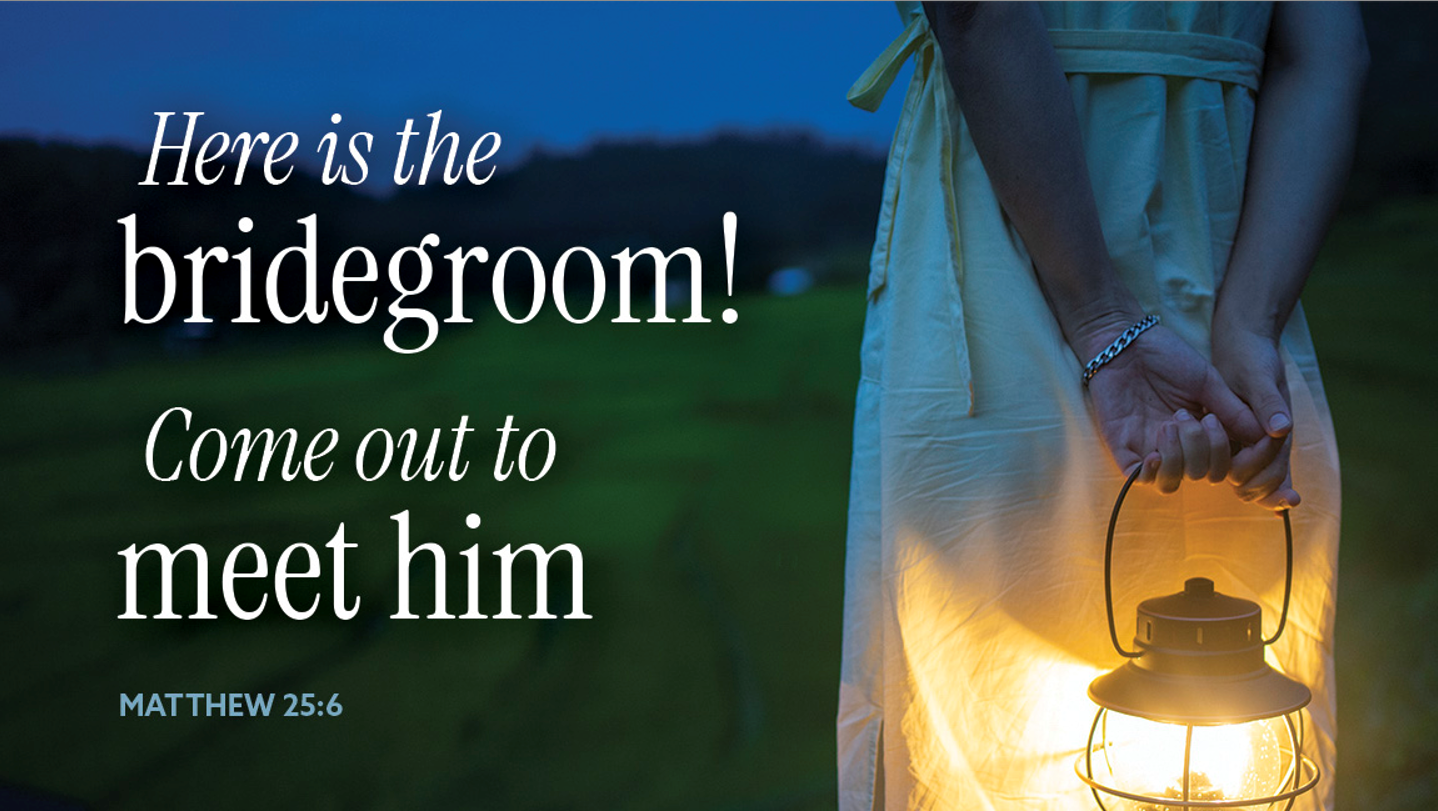
[Jesus said to the disciples:] 1 “Then the kingdom of heaven will be like this. Ten young women took their lamps and went to meet the bridegroom. 2 Five of them were foolish, and five were wise. 3 When the foolish took their lamps, they took no oil with them, 4 but the wise took flasks of oil with their lamps. 5 As the bridegroom was delayed, all of them became drowsy and slept. 6 But at midnight there was a shout, ‘Look! Here is the bridegroom! Come out to meet him.’ 7 Then all those young women got up and trimmed their lamps. 8 The foolish said to the wise, ‘Give us some of your oil, for our lamps are going out.’ 9 But the wise replied, ‘No! there will not be enough for you and for us; you had better go to the dealers and buy some for yourselves.’ 10 And while they went to buy it, the bridegroom came, and those who were ready went with him into the wedding banquet, and the door was shut. 11 Later the other young women came also, saying, ‘Lord, lord, open to us.’ 12 But he replied, ‘Truly I tell you, I do not know you.’ 13 Keep awake, therefore, for you know neither the day nor the hour.”
The gospel of the Lord.
Praise to you, O Christ.
May your Spirit move in our lives, O God, and stir up our souls, that we be emboldened by your Word, empowered by your truth, and embraced by your love, through Jesus Christ. Amen.
So my wife’s cousin from Hong Kong was in town and staying with us for the past couple weeks. And while she was here, I realised something about myself. Something that should have been obvious to me but for some strange reason I still found it surprising. Something that maybe anyone could have guessed just by knowing me, but somehow I was still caught off guard. Something that is probably typical of someone like me, this Canadian-born and raised guy but with a Chinese-looking face. And that something is… my goodness is my Cantonese ever bad. I mean, I knew it wasn’t great, but I never thought it was as bad as it actually is until I tried to hold a conversation with this pretty much Cantonese-only speaking cousin. Like it turns out, I can barely even say “good morning” in Cantonese without stuttering.
How is this such a surprise to me? Well, often when I talk to my other more-comfortable-in-speaking-Cantonese-than-English relatives and friends, they would speak to me in Cantonese and I would just respond in English. They’d sometimes have to slow down their words a little and/or explain themselves a bit when I don’t understand, and I’d have to lay off the street lingo that I’m so used to when I rap with my homies. But more often than not, our understanding of each other’s native tongue is enough for us to get by.
But this visiting cousin? Not so much. I mean, I could understand her on the most part, but she barely caught like maybe 10% of whatever I was trying to say. Perhaps I should have brushed up a bit more on my Chinese before she got here. I should have done some extra lessons on Duolingo or whatever so she and I could have communicated better. Or maybe I should have loaded up on the Canto dramas with the subtitles turned on so at least I might have been a bit more ready.
But it’s too late now, I guess. I missed my chance. I was foolish for not being more prepared.
Or was I?
Even though it was hard for me to talk to her, I still took the time to drive her around. I still took her to some of my favourite restaurants and local eats. I still gave her an unconditional ear and responded with knowing looks and understanding nods. I also showed her how to make a pretty mean cup of coffee.
The point of me telling you about my not-that-interesting life is that, well, community and relationship can happen where and how we might not expect. There were ways to communicate other than with audible words. We can relate to each other outside the language we’re used to. Together, we can find understanding.
And so I think about this parable that we get for today. It starts off with these ten young women who go to meet a bridegroom. The parable labels five of them foolish, and the other five wise. As the story progresses, we see that the foolish ones didn’t bring enough oil for their lamps and ran out while the wise ones brought extra. After the foolish couldn’t convince the wise to share, they left to replenish their stash, only to miss the bridegroom and be locked out of the party… forever.
Weird, huh? In our context, this parable means little as its described customs are foreign to us. Thankfully, we have handy someone who is able to explain this to us in simple terms: Google. According to A.I., the tradition is that when there is a wedding, the bridegroom goes to the home of his betrothed late at night for some strange reason. And as he sets off, he is met by attendants, usually young women, to walk with him and show him the way. Because it’s at night, it’ll be dark and the attendants need to escort the bridegroom with the help of their lamps lighting the path. Those without a lit lamp could be seen as an intruder, some sort of ruffian, or just your typical party-crasher.
So it was important for the attendants to make sure they had the oil they needed to keep those lamps burning. They should know to have a little extra just in case the bridegroom is inexplicably late, just as this one was. They should have cared enough to have enough, but they didn’t so that is why they were called foolish.
Or is it?
Sure, maybe that take makes sense, which means our takeaway should be that we need to be prepared and bring more than we need. Have a bit in the reserves. Make sure it’ll be enough. Otherwise, we might get denied and kept outside of the party.
But honestly? I’m not sure about that. To say that the ladies are foolish because their lamps ran out of oil seems a little mean and ungracious. If anything, call the bridegroom out for being late. Shouldn’t it be his fault? At least those ladies tried to fix their predicament. The other ladies are the ones who wouldn’t share. The so-called foolish ones were even able to find an oil dealer that was still open at that hour to restock their supply, for goodness sake.
My point is, I don’t know if the “foolishness” came from not having enough oil. I don’t know if they were locked out for not being prepared. I don’t know if the bridegroom denied even knowing them because they didn’t understand the assignment.
Rather, I wonder if they took that assignment a little too seriously, and the foolishness came from not getting the point of it all to begin with.
What I mean is, I wonder if there was a way that these ladies could have attended to the bridegroom other than what was prescribed by custom and how it’s always been done. I wonder if holding so dearly onto the need of having those lamps lit caused them to forget why they even needed them. I wonder if the bridegroom claims to not know them because they abandoned their post and thus, him. I wonder if they were locked out of the banquet because they simply weren’t there. Not there in the celebration. Not there with the bridegroom or the bride on one of the biggest days of their lives. Not there in appreciation of the honour of being chosen as an attendant in this momentous occasion.
They were too busy getting oil. They were too preoccupied with how they thought things were supposed to be. They were too focused on the tradition and forgot about the relationship.
And so then I wonder, how often do we do that? How often do we hold too tightly onto what we’re used to? How often do we force things to be the way we think they should be? How often do we focus so much on what we’re doing that we forget why we’re doing them to begin with?
See, just as I was able to relate with my wife’s cousin outside of the traditional means, I wonder if our relationships with each other could benefit from thinking outside of the box. Just as I was able communicate with her in ways other than what I was used to, I wonder if we could communicate with God in ways that we haven’t always done. Just as she and I were able to connect through alternative methods, I wonder if we could express our faith and our service and even our love for God and each other through methods that weren’t exactly part of our religious rituals and denominational demands.
I don’t mean we should change for the sake of change. I don’t mean to scrap tradition altogether. I don’t even mean that we’ve been foolish in our worship and how we do things. All I’m saying is that let’s not put the cart before the horse. Let’s not throw out the baby with the bathwater. Let’s not put our religious piety over our relationship with the God who created us out of grace and welcomes us out of mercy and connects with us out of love.
I know we are traditional and perhaps conservative in our conventions as a church. We have a rich history and we lean on it to inform us in our worship. We have ways and methods that help us to see God more clearly in the world.
At the same time, let’s not forget that we also have a God who is with us no matter how “Christian” we might feel we are. We have a God who brings us in and joins us together, diversely unique but also united in our identity as redeemed and saved people. We have a God who loves us dearly and calls us God’s own.
So let’s embrace that calling. Let’s be present in God’s presence. Let’s cherish the celebration of God’s salvation. Let’s bask in the glory of God’s welcome and reflect the truth of God’s promises of grace, mercy, and love in all that we do, all that we say, and all that we are. Thanks be to God. Amen.