
Hi everyone,
Here is the re-record of the sermon that was preached on September 20, 2026, for the 17th Sunday after Pentecost.
Bulletin
Live streamed service
Broaden our eyes, minds, and hearts, O God, that by the power of your Spirit we might know more of you and your ways of generosity and compassion, through Jesus Christ. Amen.
Before I left on holidays, I guess my social media algorithm figured out that I was leaving soon and also where I was headed, so of course it fed me a bunch of content hyping those places up. The sights, the eats, and above all, the affordable prices were all things that were highlighted for me and got me so looking forward to our trip. And I totally fell for it. Don’t get me wrong, they weren’t completely misleading or anything, there was a lot of cool things to see and good food to eat. It’s just that… well, things weren’t as cheap as I was led to believe they would be. I get that I was likely only at the touristy places that sold things at touristy prices, but most of it was on par or in a few cases even more expensive than they are here in Canada. Well, at least the things I looked at like headphones and Lego.
It got to the point where I didn’t really want to even shop anymore, as it didn’t seem worth it to fill the spare luggage that I brought with stuff that wasn’t any cheaper than at home. But then I saw it. I was at 7eleven in Japan just picking up some essentials of the 9% alcohol content variety, and it caught my eye. An unassuming deck of playing cards that, after a quick currency conversion in my head, cost only 60 Canadian cents. Sure, I didn’t really need a deck of cards but I couldn’t pass on such a deal. It’d be almost stupid not to buy them. So I did.
I took them back to the family and proudly showed them my purchase. I raved about how I randomly saw the 600 Yen price tag, and bought them with nary a second thought. And just then one of the kids stopped and was like, isn’t 600 Yen closer to 6 dollars than 60 cents?
Apparently, my mental math isn’t what it used to be.
They were right. I moved the decimal a bit too far and actually paid 10 times as much as I thought I did. And let me tell you, those cards weren’t worth 6 Canadian dollars. 0.6 dollars maybe, but for sure not 6 whole dollars. And apparently Japan doesn’t really do refunds based on remorse.
But then fast forward about a week and a half later when we were in Shanghai at a different convenience store, and guess what I saw? A pack of cards that cost 4 yuan. I didn’t want to rely on my mental math this time so I actually Googled what the conversion to Canadian dollars would be. And just as I suspected, it was like 86 cents!
So now I have two decks of cards that I don’t really need… but at least their average price went down by a fair amount…
But does that make them worth it? My family didn’t seem to think so. In fact, they thought it was moronic that I spent even more money on another deck, no matter how cheap. I thought it was worth it for the lolz alone. Like, this isn’t the first time I shared this story to just for the giggles.
But that begs the question, how do we decide? How do we figure out how much value we should attribute to things? How do we determine what is “worth it” for us?
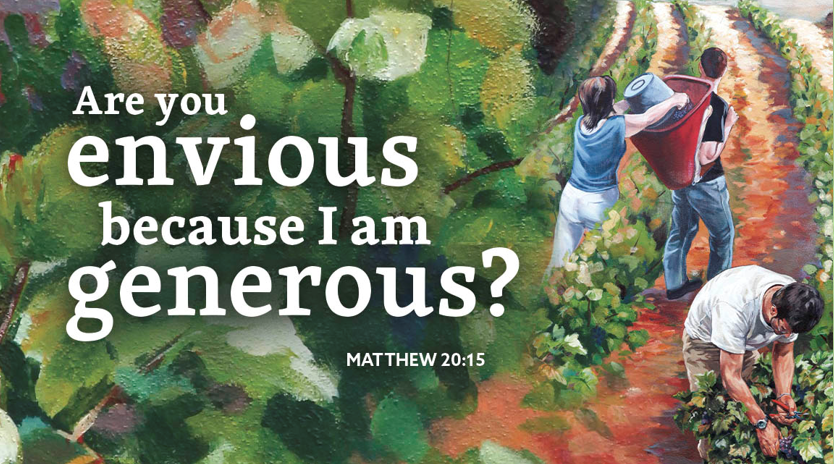
I wonder if this is what the parable in today’s gospel reading is alluding to. I mean, it’s riddled with themes of value and worth, and puts a price tag on time and in a way, people. And that isn’t always a comfortable thing for us to talk about, but it is something that we do often, both consciously and subconsciously.
Because really, since like the advent of currency being our main mode of trade, we’ve been conditioned to think that time is money. Giving up our hours is worth a certain amount. And the more hours we give, then the more money we should get. And that evolved to the more we get, the more we are worth.
Like an hour of waiting tables isn’t worth as much as an hour sitting behind a desk. An hour of hard physical labour isn’t worth as much as an hour managing the people doing hard physical labour. An hour of playing music and promoting equality apparently isn’t worth as much as owning a stadium or two and wanting to stay on the good side of your oligarch buddies.
So when these workers in the parable were paid the same amount regardless of how many hours they gave doing presumably the same field work, it would have been hard for those who worked the longest to not to feel like this was an unfair trade. It would have been very difficult for them to not feel a bit devalued in who they are. It would have been absolutely impossible for them to not feel like they were somehow cheated, ripped off, and duped by the landowner who did and paid exactly as he promised.
And really, they aren’t wrong. According to our society, that is unfair. According to how we were brought up and taught to think, paying them all the same isn’t right. According to just how the world operates, those who work harder are just worth more than those who don’t. Right?
About a year or so ago, I remember reading about a suggested a “guaranteed wage” program in Canada. The program offers everyone who fits a minimal criterion, like citizenship and age, a monthly cheque for a set amount. The rationale is that this would eliminate poverty, allow people to afford to live comfortably, and provide more opportunities for growth, both in the community and for the individual.
And this wasn’t the first time that such a program was suggested. In fact, a few test pilots were even implemented in different parts of the country and I believe in the US as well. And all of them were successful. People were happier. Worked harder. And those particular economies didn’t collapse.
So why weren’t such programs set up nationally? Well, because people feared that it looked too much like communism. They were afraid of being devalued by being paid the same as those who didn’t earn it. They felt that the system was unfair and assigned a worth to people who aren’t, in their eyes, worthy.
And while I sort of understand those concerns, I cannot share them. Because while these issues might be real, that is hardly the reason to disqualify everyone from such support. There will always be some folk who would take advantage of this kind of program, but that doesn’t make the program is bad. While there will be some who will see this as just free money to exploit, but that shouldn’t deter us from offering all people the freedom and dignity to live. Live knowing there will be food on the table. Live knowing that will have a roof over their heads. Live knowing that their value and worth is based not on their skills and talents and who their parents are, but on their simply being human.
And I think this is Jesus’ point. That while we might put value and worth on our time, our efforts, and even our very selves, in God’s eyes, we are all worth living, loving, and saving.
See the denarius that each of those workers were paid was the standard wage for a day labourer in that time because it was enough. It wasn’t abundant. They weren’t going to get rich off of it. No one could lord a denarius over anyone else. It was just enough to guarantee that you’ll get by, you’ll be comfortable, and that your place in society will be secure.
But anything less than that, then it wouldn’t be enough. And the landowner wasn’t going to strip away that dignity and value from anyone. Not those who can’t get work or those who can. Not those who society has assigned a lesser value or those who have been assigned a greater one. No those who are deemed by the world as not worthy or those who are.
Instead, the landowner tells all of them, and all of us, that our lives are worth more than what we can ever produce. Our value is more than what society can ever assign us. Who we are is more than what we can ever obtain for ourselves.
You see, we are saved by an indescribable mercy, welcomed into a kingdom and family by an unconditional grace, and declared to be children of God by an unwavering and steadfast love. This is not something we worked for, earned, or even deserve. But it is the free and generous gift from God, bestowed upon us by the very nature of creation, making us… regardless of who we are, where we’re from, and what we can offer… absolutely worth it.
So in this season after Pentecost, may we see the value that we share with all people, that we be moved to live in equity, compassion, and grace. Thanks be to God. Amen.