Hi everyone,
Here is the re-record of today’s sermon, preached on November 22, 2026, for Christ the King Sunday
Bulletin
Matthew 25:31-46
The holy gospel according to Matthew.
Glory to you, O Lord.
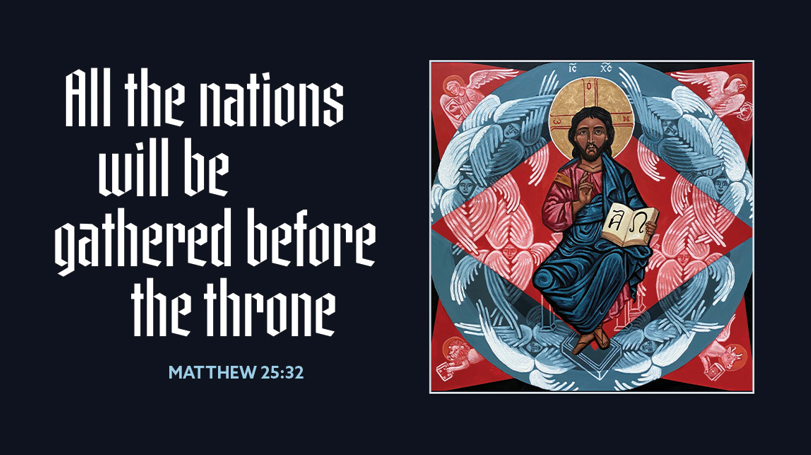
[Jesus said to the disciples:] “When the Son of Man comes in his glory and all the angels with him, then he will sit on the throne of his glory. All the nations will be gathered before him, and he will separate people one from another as a shepherd separates the sheep from the goats, and he will put the sheep at his right hand and the goats at the left.
Then the king will say to those at his right hand, ‘Come, you who are blessed by my Father, inherit the kingdom prepared for you from the foundation of the world, for I was hungry and you gave me food, I was thirsty and you gave me something to drink, I was a stranger and you welcomed me, I was naked and you gave me clothing, I was sick and you took care of me, I was in prison and you visited me.’
Then the righteous will answer him, ‘Lord, when was it that we saw you hungry and gave you food or thirsty and gave you something to drink? And when was it that we saw you a stranger and welcomed you or naked and gave you clothing? And when was it that we saw you sick or in prison and visited you?’ And the king will answer them, ‘Truly I tell you, just as you did it to one of the least of these brothers and sisters of mine, you did it to me.’
Then he will say to those at his left hand, ‘You who are accursed, depart from me into the eternal fire prepared for the devil and his angels, for I was hungry and you gave me no food, I was thirsty and you gave me nothing to drink, I was a stranger and you did not welcome me, naked and you did not give me clothing, sick and in prison and you did not visit me.’
Then they also will answer, ‘Lord, when was it that we saw you hungry or thirsty or a stranger or naked or sick or in prison and did not take care of you?’ Then he will answer them, ‘Truly I tell you, just as you did not do it to one of the least of these, you did not do it to me.’ And these will go away into eternal punishment but the righteous into eternal life.”
The gospel of the Lord.
Praise to you, O Christ.
SERMON
May the eyes of our hearts be opened, O Lord, that by your Spirit we may see, recognise, and know the hope to which we have been called, through Jesus Christ, our Shepherd and Saviour. Amen.
Thank… GOODNESS it’s finally Christ the King Sunday, am I right? What’s the hurry you ask? Well, I’m glad you asked, because finally we’ve made it to this day, the last day of the church calendar year, the end of this Lectionary Cycle Year A, this year that we have been focusing on Matthew… oh Matthew. So now we can at least finally put this book to rest for another 2 years before we have to open its difficult pages yet again.
Wait, what’s wrong with Matthew you ask? Well, I’m glad you asked that as well. You see, it’s just that… well, it’s full of lessons on the wrongness of the interpretations of the Old Testament laws that the people have loved and cherished for so long. It’s full of examples of how the old guard, the familiar doctrines and understandings, the passed-down-from-generation-to-generation traditions and customs just aren’t up to snuff with the more “faithful” way of doing things. And as we’ve seen in the past number of weeks, it’s full of confusing parables telling us about the greatness of the kingdom of heaven and points out just how much we’ve so missed the mark. “Mark” as in goal, that is, not the gospel. Which, incidentally, we do miss as well when we’re talking about Matthew. And don’t even get me started on how those parables label us as unforgiving, unfaithful, and un-fiscally responsible when it comes to debt and talents and lamp oil.
So Matthew is just a bit too heavy on the finger wagging and theology-shaming, and maybe the Lectionary cycle could be better off without it.
Or could it?
Maybe you don’t share this same sentiment over this Lectionary Year A. Maybe you don’t feel this same way about this gospel according to Matthew. Maybe you don’t think it’s fair to pigeon hole these 52-ish Sunday’s worth of lessons just because they don’t fit into a particular paradigm. And to be honest, you probably shouldn’t. Because all of that would be totally ridiculous.
I mean, really, it would be ridiculous to squeeze a whole year into a tiny box and label it as bad because of a few things we don’t like, wouldn’t it? It would be ludicrous to sum up this gospel by a couple talking points that we might not be fans of, am I right? It would be completely nonsensical to reduce the entire worth of anything… or anyone… by our assumptions, preferences, or biases. Because if we do, we just might miss Christ present in it, or them, altogether.
Yet, if we’re honest, we kind of still do it anyway, don’t we?
Like, don’t we size people up by their age, gender, and ethnicity? Don’t we assume we know all we need to know about them after learning where they’re from, what religion they practice, or even who they voted for. Don’t we, inadvertently or advertently, draw lines between groups and individuals, based on our own paradigms and viewpoints? And these lines have become all or nothing. Like you’re either on this side or that. In or out. Us or them. There is nothing in between.
And I guess that’s understandable? It’s kind of in our nature to try to make sense of things through a binary lens. It’s ingrained in us to categorize what we see as this or that when interpreting the world. We are taught, at some point in our lives, that life is basically a collection of 1’s and 0’s that makes up this program in which we live. And isn’t that what this whole parable we get today is all about? Discerning between good and bad? Determining who is in and who isn’t? Drawing that line between the sheep and the goats?
Now, I should say that the sheep in this case are actually the good and favourable ones, not like how we would today use the term “sheep” to refer to those mindless folk with no opinion of their own that would follow whatever trend or cult or misguided leader. And the goats in this story are the bad and not-so-favourable ones, which also is very unlike how these days calling someone the GOAT means that they’re the greatest of all time. Words, am I right?
Anyway, the parable has the two groups split apart. Sectioned off from each other. Segregated, if you will. With the sheep being those unknowingly generous and gracious faithful followers of Jesus, and the goats being the equally unknowing, but not so generous or gracious or all that faithful for that matter, but also followers of Jesus.
And perhaps when we hear this parable, be it the first or second or umpteenth time, our minds might have gone to pinpointing those in our lives who we think Jesus would have considered to belong on the goat side of that line. Those people who weren’t generous with us so they don’t deserve our time or compassion. Those people who aren’t kind to us so they’re going to get what’s coming to them. Those people who didn’t laugh at our jokes or paid enough attention to our carefully crafted sermons so they’ll see who’s laughing after Jesus is through with them…
…but then we might realise, we just put them into a box. We just pushed them to the other side of that line. We just acted like the very goats we condemned them to be.
And that’s the thing, if we look closely enough at others and ourselves, we’ll soon recognise both sheep and goat characteristics simultaneously side-by-side in everyone. If we paid enough attention, we’d see that, just like how we can’t or shouldn’t write off the whole gospel according to Matthew based on a couple of parables we might not be comfortable with, we’re all much too complex to fit in a box or on just one side of that line. And if we open our hearts enough, we’ll see how God’s welcome can and does extend to everyone, no matter how we regard them, what we label them as, or which side of the line we put them on.
Just as we’ve likely heard before from Nadia Bolz-Weber, “Every time we draw a line between us and other, Jesus is always on the other side of it.” Not necessarily in retaliation, mind you, but to show us how he can be present in those we don’t like, those we don’t want to be like, those we do everything we can to never be like. But seeing Jesus on the other side helps us to realise that we actually have more in common than we’d want to admit. Perhaps not in personality or worldview or favourite sports teams, but in that all of us, even when we were goats, we are regarded like sheep. Even when we were sinners, we are reformed to be saints. Even when we dwelled in the darkness, God recreates us as children of the light and invites us to be part of the kingdom.
Not just in crossing the line, but erasing it. Not to make us all agree, but to bring us together in love. Not to ignore our identity and uniqueness, but to enhance the value of diversity in unity as the one body of Christ.
You see, we aren’t called to figure out who are sheep and who are goats. We aren’t called to determine who is saved or who isn’t. We most certainly aren’t called to write people off or categorize them according to our own opinions. Rather, we’re called to see how we are loved and to love back. We’re called to recognise Christ in our community, in strangers, and in ourselves. We’re called to be God’s complex people in the world: both good and bad, equally broken and healed, simultaneously sinner and saint.
I don’t even know if there is a box big enough to contain all our complexities. I don’t think there is a label that can accurately describe who we are and who we are created to be. I don’t think there is a line thick enough that can’t be wiped away by the grace of Christ that is big enough to cover us all, the love of God that is wide enough to save us all, and the fellowship of the Holy Spirit that is welcoming enough to include us all.
So on this Christ the King Sunday, as we close off this very appreciated Lectionary year A and look ahead to Lectionary year B, may we see Christ present in our lives all year round and beyond, may we feel God leading and guiding us in all that we say and do, and may we know the Spirit with and within and all around us, comforting us and reminding us of our call to be God’s beloved and redeemed people in the world. Thanks be to God. Amen.