
Hi everyone,
Here is the re-record of the sermon that was preached for the 21st Sunday after Pentecost, October 18, 2026. You’ll find the gospel lesson and sermon manuscript under the video.
Gospel: Matthew 22:15-22
The holy gospel according to Matthew.
Glory to you, O Lord.
15 The Pharisees went and plotted to entrap [Jesus] in what he said. 16 So they sent their disciples to him, along with the Herodians, saying, “Teacher, we know that you are sincere, and teach the way of God in accordance with truth, and show deference to no one, for you do not regard people with partiality. 17 Tell us, then, what you think. Is it lawful to pay taxes to Caesar or not?” 18 But Jesus, aware of their malice, said, “Why are you putting me to the test, you hypocrites? 19 Show me the coin used for the tax.” And they brought him a denarius. 20 Then he said to them, “Whose head is this and whose title?” 21 They answered, “Caesar’s.” Then he said to them, “Give therefore to Caesar the things that are Caesar’s and to God the things that are God’s.” 22 When they heard this, they were amazed, and they left him and went away.
The gospel of the Lord.
Praise to you, O Christ.
Sermon
By your Word, O God, and the power of your Spirit, may we see you, hear you, and feel you present among us this day and always. Amen.
What in the wide, wide world of elections is going on here?
In case you aren’t sure what the heck I’m talking about, I’m not sure I do either. All I know is that we have two elections very close to each other here in BC, one municipal or local or whatever they call it, and the other provincial. This has never happened before in this part of the world, and we could be facing a whole regime change for us, which I would think isn’t exactly ideal. But it is what it is, and hopefully all of you this pertains to got the dates right, because one of them was yesterday.
And I know, I know, some people feel like we shouldn’t be talking about politics in sermons, mixing church and state, or even canvassing in our Narthex on a Sunday morning, but I bring this up not to talk about politics per se, but more about what the politics of late have brought out of us all.
Because, politics has become such a divisive topic, hasn’t it? Maybe it always has been for many, but all I know is that for me, I’ve never had to put so much effort as I have lately to defend the policies that I agree with, or back up my opinions with credible sources, or protect the dignity of another human being who happens to be running for some sort of office, because they are so unjustly ragged on not just by their political opponent, but by their opponent’s followers as well.
It’s like, it isn’t about the candidates campaigning based on what they can do, have to offer, and can bring to the table, but more what their opponent can’t. It isn’t about having a better platform than the rest, but just poking holes in and discrediting the other’s. It isn’t about coming with your best foot forward, but it’s about it’s about name-calling, finger-pointing, and downright blaming for everything. And people seem to be jumping right on that bandwagon of whomever they slightly resonate with.
Why? Well, I saw this thing the other day that made a lot of sense to me. It was saying that this brand of “blame game” politics is enticing to people, because deep down, we’re all looking for someone to pin our problems on. We all want to pass the buck when it comes to how we’re affected by the going’s on around us. We all, in our own way, want to point our fingers and villainize another person or group, a whole country, or even an ideal, mentality, or religion for causing our perceived hurt and pain.
And I’m not saying that we can’t blame anyone for anything, but I’m just saying that not all the blame should land on them. Because once the thought of one person or group being solely at fault for all this sneaks into our heads? Well then suddenly that person, anyone who belongs to that nationality or ethnicity, or anyone who claims to follow that religion or buys into that philosophy, can never do any right in our eyes.
It’s like our interpretations of them become fixed. Our opinions become immovable. Our wild assumptions become veritable facts in our minds that have completely closed off to any possibility that we could be wrong about them.
And that’s dangerous. That is what tears families, communities, and nations apart. That is pretty much what got Jesus killed.
See in today’s gospel reading, this mentality is quite clear in the Pharisees. They saw Jesus as this rabble rouser who won’t stop scoffing at their tried-and-true traditions, throwing dirt in the face of everything they found sacred, and calling out their ill-gotten power and wealth. So to them, Jesus could do no right. They just had to get his followers to see him the same way so they would put their allegiance back to where it belongs, namely back with their nation and nation’s leaders.
And so the Pharisees joined forces with the Herodians and came up with a trap. One so sinister and diabolical that it completely mirrors their “damned if he does, damned if he doesn’t” opinion of Jesus. One so contrived and conniving that ain’t no one getting out of it. One so ingenious yet insidious that not even Satan could have come up with something better. See, they asked Jesus if it was lawful to pay taxes or not. I know right? Gasp.
But understand how this could be a no-win situation for Jesus. Or at least, it’s a no-win for him if you already think that Jesus is a total loser. The tax in question was just one denarius a year to Rome, which served as a sort of protection payment like we see the street gangs demand from local shop owners. Basically, it’s ancient shake down money on an international scale.
So if Jesus says yes, then he’s a Roman sympathizer and a traitor. But if he says no, then he can be arrested by Rome for sedition and insurrection. Either case, a tall glass of discredit is coming right up, because Jesus is donezo.
Or so they thought.
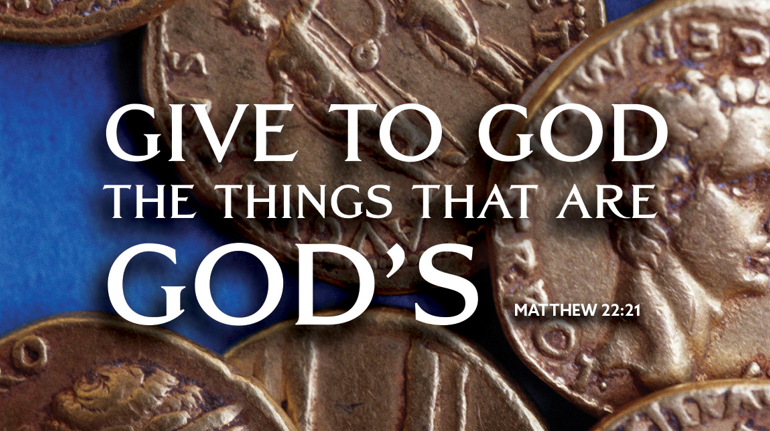
We know what Jesus does, he takes a coin, points out the Ceasar’s image on it, and says “give to Ceasar what is Caesar’s and to God what is God’s.”
And… talk about ingenious. Jesus effectively separated the value they put on their nationalism and patriotism with the value that we have as God’s people. Jesus pointed out how our worldly assumptions and labels that we put on each other and ourselves don’t change our position in God’s family and kingdom. In just a few words, Jesus reminded them of who they are and whose they are, as well as who they aren’t and whose they aren’t.
Jesus was telling them to stop interpreting not just him but all people who aren’t them as lesser, outsider, and ne’er do wells. That anyone who doesn’t fit in their narrow minds of what is right will always be wrong. That everyone who claims a different mentality, leans a different slant, or wears a different colour is someone who is worthy of their hate.
This isn’t just about politics, although it totally applies. But I’ve seen people having fist fights over proper driving etiquette, families torn apart over disagreements on who to love, churches split over differing opinions on how we can be God’s hands and feet in the world.
The funny thing about the gospel story is that when Jesus asks to see the coin used in the tax, he doesn’t pull it out of his own pocket. He doesn’t grab one from his disciples who were likely right behind him. He doesn’t even look up an image on Google. Rather, he asks for one and the Pharisees and Herodians produce one for him. And while it isn’t clear on where they got it from, like from the bank, the offering plate, or even their own pocket, it didn’t seem that hard for them to obtain it at all. It sounds like the coin with the graven image of Caesar on it was easily accessible, very attainable, totally within reach for them.
No wonder Jesus calls them hypocrites.
While they were trying to trap Jesus with a question with no right answer, they already answered it for him. While they thought they had Jesus backed up in a corner, they only pointed out their own folly. While they wanted everyone to see how Jesus was all wrong, Jesus helped them realise that they weren’t exactly all right.
And so I wonder if that is Jesus’ lesson for us today. Not that we need to be called out as hypocrites, but perhaps we need to learn humility in some area of our lives. Not that we need to be reprimanded for pointing our fingers, but maybe gently reminded that when we do, 3 or 4 fingers are pointed back at us, depending on how you hold your hand when you point. Not that we need to take the blame for everything bad that happens to us, but rather that all that blame doesn’t always need to be outsourced onto others to help us feel better about ourselves.
Instead, we are called to act with grace. Live with mercy. And learn to see all people as God does: fallen but forgiven, hypocritical but held in grace, sinners but saved by God’s steadfast and unending love. And above all, realise that while we all might have differences in opinion, tradition, and political worldview, we all are, have always been, and will continue to be joined as one in this broken, brought down, and murdered body of Christ, and together with Christ we have been healed, lifted up, and welcomed to live in this Easter life made possible through the resurrection.
In this season after Pentecost, may we embrace our dualistic nature of sinner and saint and recognise that same nature in our neighbours, family members, and whole community, that we can live in and reflect God’s love and grace in all that we do and with all whom we encounter. All thanks and praise be to God. Amen.


