This is the re-record of the sermon that was preached on July 12, 2026, for the 7th Sunday after Pentecost
Readings
Bulletin
Live-streamed service
Holy God, may your Spirit fall afresh on us this day, that we be led and guided on your paths of righteousness and faithfulness, through Jesus Christ. Amen.
So many of you know that my family and I will be travelling to parts of east Asia in a few weeks, and while we’re pretty excited about it (I think), we aren’t exactly completely prepared. I mean we booked and paid for everything we need to, so we can get there and have a place to stay and eventually we will come back, but it’s the fine details that aren’t ironed out yet, like vaccinations if needed, what we should take with us and what to just buy there, and… well, mostly our itinerary in general.
Asia is a big place with lots of things to see, so we have to be selective of what we’ll do, where we’ll go, and what kinds of foods to eat in order to make the most of our time. I mean I don’t want to go all the way there just to eat fast food for every meal and stay in our hotel using our devices and screens every day. So, we’re doing the research and planning to make sure that doesn’t happen. But ironically enough, we had to turn to our devices and screens to help us with this. I mean, social media has been almost essential in this regard as we could get a preview of what places are like, the vibe they offer, and if it’d be something we’d like to experience in real life or not.
Take, for example, an Instagram reel my wife forwarded to me a little while ago. It displayed some café in one of the cities in China that we’re going to. Cozy décor, highly rated coffee and food, and of course, reasonable prices. Sounds like bare minimum, right? Well, what caught her attention was that apparently, according to this reel, the café only employs the best-looking males around. Like we’re talking unreal model levels of good-looking-ness. So my wife sent it to me and was like, “can we go?”
Now I’m not the jealous type, but before I could say “sure we can go, but I’m not going to accept any jobs offers,” she showed me another reel that was about these two girls that actually did go to this café, and the décor and food and everything was as described, except the baristas who were average looking at best, and she messaged, “oh, nevermind.” Turns out, the first reel used AI to replace all the regular looking dudes with these Asian Adonis Lutheran pastor lookalikes. I was surprised that I was so fooled by the AI generated edits. My wife was more disappointed than anything else.
But such is life with AI now, am I right? It’s like we have to question everything now out of necessity, because AI has made the unbelievable believable, the incredible credible, and the implausible plausible. Seeing is no longer believing. In fact, AI has gotten so good now that seeing is almost enough reason not to believe. It’s become harder and harder to tell the difference.
Don’t get me wrong, I’m not suggesting that we simply unplug the internet and go back to the stone ages. Well, maybe I wouldn’t mind going back to the 80s and a bit of the early 90s because that was a pretty awesome time to be alive. But I’m saying that as the world continues to go, as progress continues to progress, as this Artificial Intelligence gets more and more intelligent, we have to be careful with what we receive as truth, what we believe in, and where we put our faith.
Trust the wrong thing and you’re naïve, believe the wrong thing and you’re a fool, put your faith in the wrong thing, and you’re… sheep. And figuring out which is which and what is what and who is who has become more difficult than ever. But isn’t this how life has always been?
Sure, these days AI has made it extremely difficult to know what is true or not, but scams and frauds and hoaxes have happened throughout the ages and gave people trust issues. From false prophets, con artists, and just plain old liars, people have been fooled, duped, and led astray ever since humans learned how to communicate and manipulate.
So it’s a no wonder that Jesus had to spend so much time teaching his disciples and the people. It’s no wonder that the religious leaders of the time didn’t even want to entertain this new-fangled way of thinking and living. It’s a no wonder that Jesus ended up rejected by the very people he came to save.
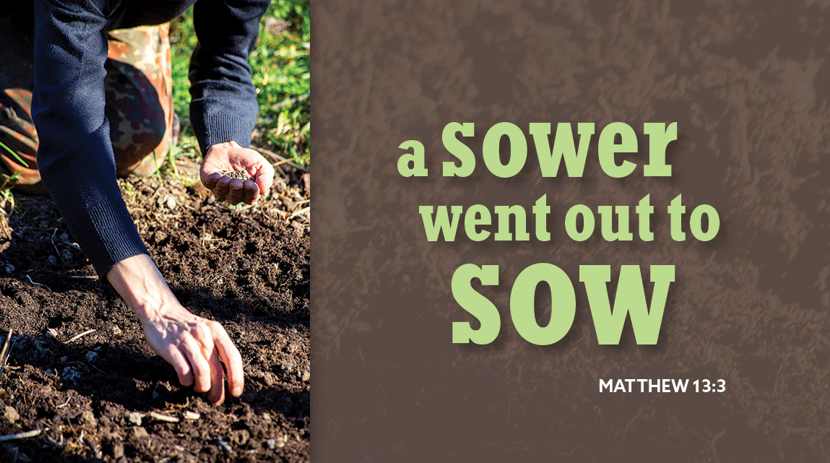
“If you have ears, hear!” Jesus says emphatically after sharing this parable of a farmer doing farming things. As I’m sure you’re aware, I don’t know much about plants and stuff, but I have to admit that these farmer’s actions seem odd to even me, as I’m sure was the case to those who first heard this wildly spun tale. I mean, shouldn’t the farmer be a bit more selective in where those seeds are dropped? Shouldn’t the farmer be a bit more conservative than haphazardly throwing seeds anywhere? Shouldn’t the farmer be a bit more concerned with the efficiency and effectiveness of this seed rearing? Because some of that ground looks pretty suspect. Some of those thorns look sketchy. Some of those birds circling the air look pretty untrustworthy and up to no good.
So the farmer should be careful, we’d think, as seeds might not seed in all places. The farmer ought to be cautious, we’d surmise, as we do the calculations around cost-effectiveness and return on seed investments. The farmer better smarten up, we’d say, in this world of mistrust and skepticism around what is best for these precious seeds. If it were up to us, this story would be very different. If it were up to us, we’d be sure that the seed landed in the best spots only. If it were up to us, we wouldn’t leave anything to chance but be sure that those seeds are given the best opportunities of survival based on fact-checked science and common sense.
But, as we know, the farmer doesn’t, isn’t, and won’t. The farmer does everything against the farmer handbook in terms of good seeding. The farmer seems to trust too much and question too little. And maybe that’s the point.
It isn’t spelled out in today’s readings, but this story starts off Jesus’ series of “the kingdom of heaven is like” parables, where he takes ordinary things, turns them on their heads, and compares that with the mentality of God, the actions of the Spirit, and just how the kingdom of heaven is.
And right after this passage in Matthew chapter 13, in a portion that also isn’t included in today’s reading, the disciples ask Jesus why he bothers teaching in parables. Jesus responds, “whoever has, will get more, and whoever doesn’t have, even what they have will be taken away.”
So then, by this parable and the others, Jesus is making sure we all have.
It doesn’t matter if we’ll receive it. It doesn’t matter if we’ll grow from it. It doesn’t even matter if we’ll believe in it. But instead, Jesus wants us to be shown love, strengthened to give love, and just be loved.
See the actions of the farmer don’t make sense if we assume their motivations will line up with ours. They seem careless if their goal was to be as effective and efficient as possible to grow crops. We can’t believe that the kingdom of heaven can be so haphazardly trusting without discernment, without debate, without deciding on who is actually worthy of receiving the good news of grace and salvation or not.
In a world where we have a hard time trusting what we see, God entrusts us with the truth. In a time when we have to be really sure before we can believe in anything, God gives to and provides for us in spite of unbelief. In this life where faith has to be dissected, deconstructed, and dismantled before its worth anything, it’s the faith of Jesus that is enough to not just show us the kingdom, but to invite, welcome, and include us into it anyway.
I know, this might not help our faith grow. It doesn’t allow us to believe easier. We still might find it hard to trust. But the point is that where we are in our trust isn’t indicative of who we are in Christ. How likely we are to accept doesn’t change what God gives. The kind of soil we might be compared to doesn’t stop the farmer from presenting us with that seed anyway.
The seed of good news, the seed of hope, the seed of God’s everlasting and eternal love. Believe it or not, it is what we are given.
In this season after Pentecost, may we be constantly changed and renewed by the grace of God, that we could more boldly live in an unbelievable faith. Thanks be to God. Amen.