Hi everyone,
Welcome to worship for this 4th Sunday in Lent, landing on March 15, 2026!
The bulletin for this service can be found here. You can use the bulletin or the words that will appear on your screen to follow along with the service. The sermon manuscript is also found in the bulletin as well as on this page below the video.
For a fuller online worship experience, you are invited to have a lit candle in your space for the majority of the service, and extinguish it after the sending hymn when the altar candles are extinguished. You are also welcome to participate in communion if you are comfortable, by having something small to eat and drink prepared for the appropriate time in the service. Further instruction will be given then.
May God’s unending love inspire you to live in hope and peace, today and always!
Gracious God, illumine our hearts and minds with the power of your Spirit, that we might see you more clearly, hear you more distinctly, and love you more fiercely, through Jesus Christ. Amen.
I want to let you all in on a little secret: I hate losing an argument.
Ok, maybe “hate” is too strong a word, but I really do dislike it. And it’s not like I get into very many arguments at all as I’m a pretty easy-going guy. But whenever I do find myself in one, you better believe that I’m in it to win it.
I don’t know, maybe it’s the embarrassment that comes with not being right. Maybe it’s just the thought of my integrity, clout, and trustworthiness being questioned. Or maybe it’s just the fear of losing authority and power whenever I am wrong.
So I guess it’s a good thing that I’m barely ever wrong then.
But seriously, I don’t think I’m alone in this. I don’t think I’m the only one who doesn’t like to be told that I’m wrong when I’m certain that I’m right. I’m not the only one who is tempted to pull out all the stops in rationalizing, justifying, and validating all of my opinions and assertions. I’m not the only one who… well… maybe it is the right word… hates to lose an argument.
Because if I were, then I’m not sure there would be so much division in and around our lives. There probably wouldn’t be so many broken relationships in our society and the next. I don’t think there would be all the violence and war that dotted human history since the beginning of time. Maybe all of that didn’t stem from losing an argument per se, but I’m pretty sure it came from differing parties both believing that they’re right, literally to death.
Everyone wants to be right. No one wants to be wrong. Arguing is like the choice way to figure out which is which.
And I think this mentality is quite apparent in the story we get in today’s gospel lesson, where there’s all this back and forth debating, insinuating, and gaslighting going on. It’s like pretty much everyone with a speaking role is protecting something. Be it their opinions, their reputations, or their very selves, they all go from the defensive to the offensive in this argument that doesn’t really get them anywhere, doesn’t solve anything, doesn’t at all display any kind of grace, love, or community.
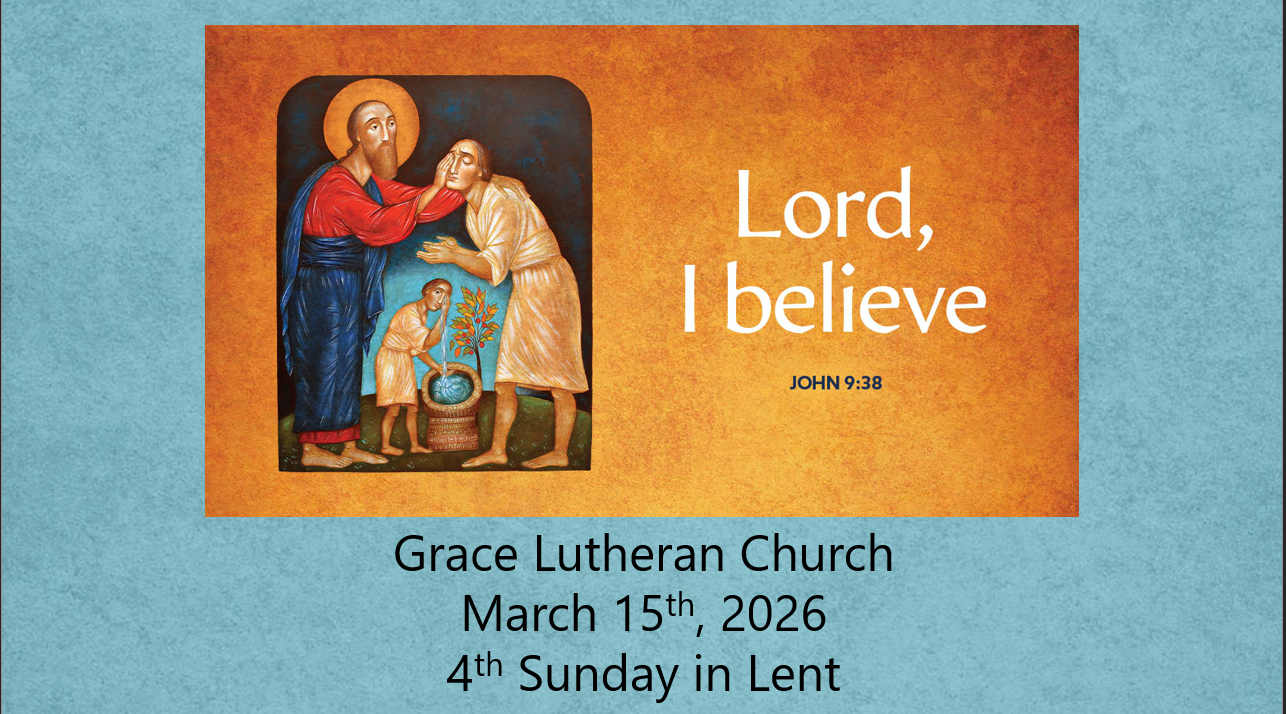
We’re familiar with the story. There is a man born blind that has been begging as a way to support himself for as long as anyone can remember. This of course wouldn’t be an easy life to begin with, but tie that with the rampant stigma of the day against physical ailments or disabilities? Then it’s an actual surprise that the man even made it this long when his blindness would have been thought to be ordained by God as some sort of divine punishment.
But Jesus didn’t see it this way. Instead, he responds to the innocent and borderline naïve “who sinned” question posed by the disciples, that sin didn’t cause this man to be blind at all, but sin did blind everyone else to him, his needs, and to God present in the whole situation. Because right away in an action that I’m glad that blind man couldn’t see, Jesus spits in the dirt to make some mud and spreads that mud on the man’s face… on his eyes no less… and heals him.
And you’d think the story could end there. I mean it feels like a good high note to stop at. Like if the point of the story was to show us that Jesus loves and heals even those that we don’t think deserve it, then mission accomplished and we can slap on a “happily ever after” and move on to the next episode.
But of course, that’s not what happened. The story didn’t end there. Perhaps more needs to be said before the point is made.
Word spread about the man formally known as the blind man now being known as the man formally known as the blind man, and as you could imagine, it was unbelievable to all who heard it. Never since the beginning of time has anyone born blind been healed and received sight. Never in the history of humans has anyone’s closed eyes been opened. Never in their limited experience of the entirety of creation had they ever seen something to go this much against their beliefs, their knowledge, their pre-set notions of what is right and what is wrong.
And when the Pharisees got a hold of the news? That’s when all hell broke loose. They summon the man and they argued with him. They wanted to show how he is wrong. They wanted to prove their stance as right. They even bring the man’s parents into the fight, but they didn’t support their son in his blindness, why would they support him in his sightedness? They were getting no where.
So the “not-fair-you-see” Pharisees couldn’t convince the man that they were right and he was wrong, not with their compelling points around law and theology, not after leaning on their education and authority, not even by name-dropping Moses could they win their argument. So instead, they just booted him out of the community. The man formerly known as the blind man got himself cancelled.
So who was right and who was wrong? To us it seems pretty clear. But back in those days it wouldn’t have been so obvious. These are the Pharisees we’re talking about here. They were the smartest of the smart, the most respected, most powerful, most well versed on what is right and wrong. How could anyone, let alone a blind beggar born entirely in sin, ever hold a candle against their arguments?
And really, the Pharisees weren’t wrong. Sure, they were mean, nasty, and unpleasant, but their claims were correct. It was illegal to heal on the Sabbath, it was sinful to disrespect the Torah like that, it was wrong to disobey, question, or change the status quo.
But at the same time, the man wasn’t wrong either. He was blind. He can see now. He really doesn’t know where Jesus was at that exact moment when they asked. So who really wins? Is it a stalemate? Did any of it really matter?
And maybe that’s just it. The point is that being right isn’t the point.
Arguments happen. Disagreements occur. Difference in opinion is inevitable. There is no denying that. But the problem is when in the heat of the moment, when emotions are flaring, when we are blinded by our need to be right and win, we miss Jesus there, in the middle of it all. Not skirting the issue and invalidating our feelings. Not taking sides and joining in on the finger-pointing and the blame game. Not even in calling us out for getting caught up in things that might not even matter.
But Jesus welcomes. Jesus accompanies. Jesus loves.
In the midst of all the strife and friction, Jesus reminds us who we are as God’s people. While we might still disagree and see things in completely different ways from our opponents, Jesus reminds us of who he is as the Messiah and Saviour of the world. Even when we were all seeped in sin together with everyone who has ever lived, is living, and will ever live, Jesus reveals to us all the salvation found in God’s grace and reminds us that the point was never to win arguments, but to know that we are loved regardless even if we’re right or wrong or somewhere in between.
Loved in our differing opinions. Loved in our misguided perceptions. Loved in our irritating desperation to win.
See while the world tells us that there is respect in being right, worthiness in winning arguments, power in putting your opponents in their place, Jesus tells us that there is more to be gained in grace, there is a freedom in forgiveness, there is a peace in swallowing our pride and prioritizing community. Because our faith was never about winning or losing, looking strong or weak, or even taking rewards or punishments, but it has always been about our relationship with God and each other, our service to our neighbours, and showing all people how they, however different they are from us, continue to be held as a beloved child of God.
And perhaps once we see that, we’ll see and recognise how God holds us, binds us together, and opens our eyes to the salvation that is so freely given to us all, rich or poor, healthy or sick, right or wrong. All.
So as we continue through this season of Lent, may we see God’s presence with us, not pointing fingers or calling us out, but in loving us as we are, flaws and brokenness and all, which has always been the point. Thanks be to God. Amen.